
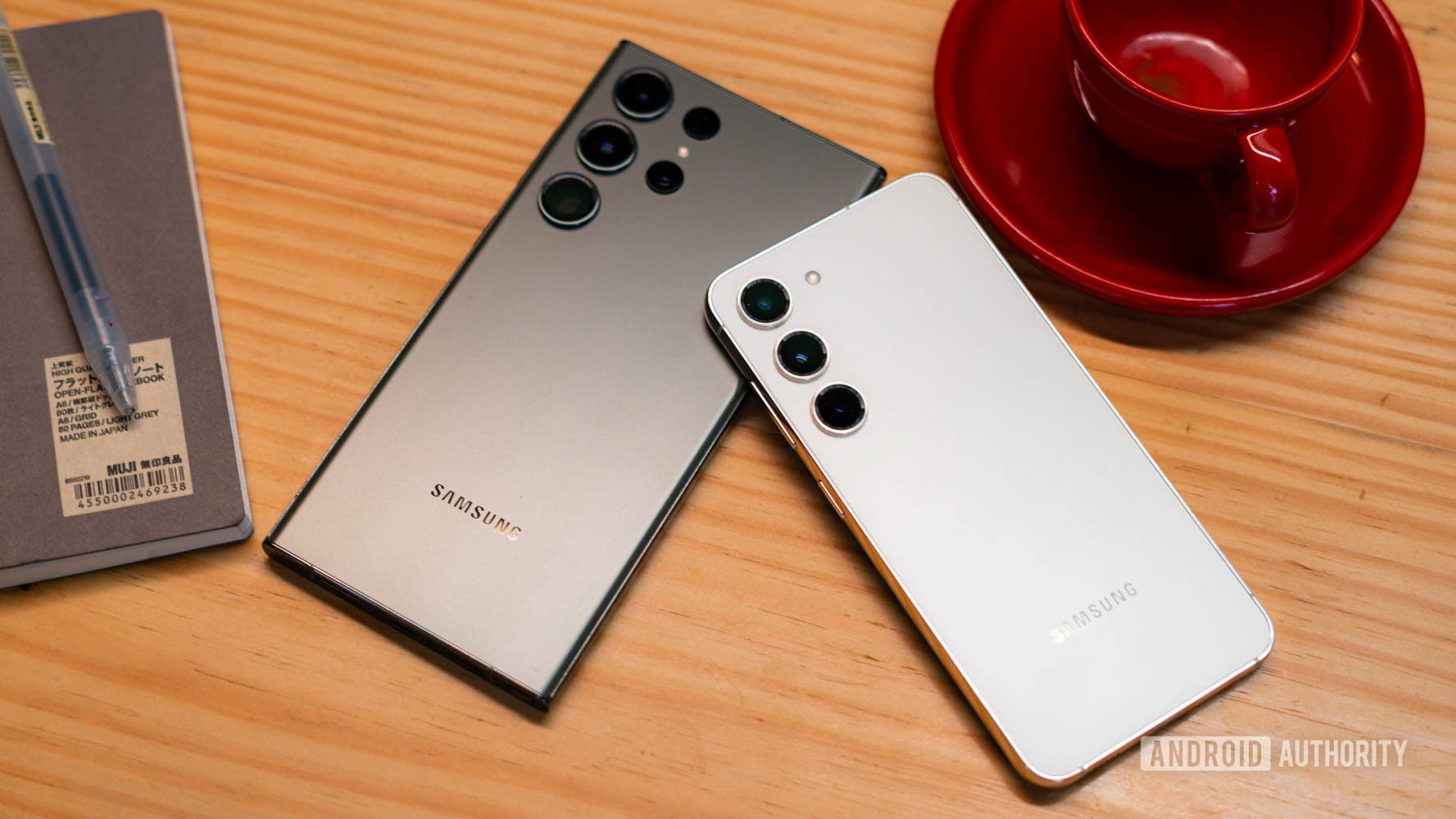
I’m your stereotypical power user. Every year, I tend to get myself the best that the Android world offers. Earlier, it used to be a OnePlus phone for its great balance of size, performance, and clean software. Lately, it’s been a Samsung flagship. My use case is productivity and battery-life-oriented, and solid cameras are essential. So it shouldn’t be a surprise that when the Samsung Galaxy S23 Ultra launched earlier this year, I swapped my SIM card for Samsung’s latest and greatest and called it a day.
The Galaxy S23 Ultra is the de-facto choice if you want a straight-up Android flagship.
The experience was largely unchanged compared to my Galaxy S22 Ultra. Slightly easier to hold in hand thanks to the flatter edges, a bit faster, and a lot longer lasting. Predictable but nothing particularly exciting. However, lately, I’ve been longing for a more practical option. A smartphone that didn’t feel like a tablet in my hands, that would prioritize ergonomics, and that fit better in my pocket. Sure, there’s the Pixel 7, but the feature compromise over the Pro-variant wasn’t something I was interested in. So when Samsung reached out to me with an opportunity to test drive the regular Samsung Galaxy S23, I jumped on it. I was intrigued to know if smaller flagships had finally gotten around their limitations in battery life and performance.
Snowflake customers can now take advantage of Gemini 4 Argon natively in Snowflake’s AI tools—bringing deep reasoning and visual analysis […]
For life sciences organizations, real-world data (RWD) has become one of the enterprise’s most valuable assets. Operationalized as real-world evidence […]
Enterprise HR and financial data is essential to understand how a business runs. But it doesn’t tell the full story […]
Our services help both the big and small organisations in the identification of security breaches and provide outclass solutions to prevent any potential harm.
